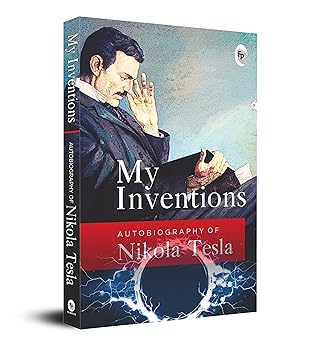
My Inventions: The Autobiography of Nikola Tesla
By Nikola Tesla
Core Book Summary
My Inventions is the fascinating, firsthand autobiographical account of Nikola Tesla, one of history's most brilliant, eccentric, and underappreciated inventors. Originally published as a series of articles in the Electrical Experimenter magazine in 1919, the book offers an unparalleled glimpse into the mind of the man who gave the world the alternating current (AC) electrical system, the Tesla coil, and the foundations for radio, robotics, and wireless communication. Tesla was not a traditional engineer who relied solely on trial and error (like his rival, Thomas Edison). Instead, the book details his extraordinary mental abilities. Tesla possessed an extreme form of eidetic (photographic) memory and a condition akin to synesthesia. From a young age, he was plagued by blinding flashes of light accompanied by vivid hallucinations. He learned to control this ability, ultimately using his mind as a virtual laboratory. Tesla claims that he could completely construct a machine, run it, test it for wear and tear, and dismantle it entirely within his imagination before ever sketching a single blueprint on paper. The autobiography chronicles his journey from his childhood in Smiljan (modern-day Croatia), his intense educational pursuits where he barely slept, to his fateful immigration to the United States with only four cents in his pocket. Tesla candidly discusses his brief, tumultuous employment with Thomas Edison. Edison, a champion of the inefficient direct current (DC) system, dismissed Tesla's ideas for an AC motor. When Tesla redesigned Edison's DC generators, Edison infamously refused to pay the promised $50,000 bonus, calling it an 'American joke.' This led to their bitter split and the subsequent 'War of the Currents,' which Tesla and George Westinghouse ultimately won by proving AC power was the only viable way to transmit electricity over long distances, culminating in the lighting of the 1893 Chicago World's Fair. However, My Inventions is more than just a recounting of technical victories; it is a profound philosophical reflection on the purpose of invention. Tesla deeply believed that the true reward of an inventor is not immense wealth, but the joy of creation and the betterment of humanity. He cared very little for money, famously tearing up his lucrative royalty contract with Westinghouse to save the company from bankruptcy. In his later chapters, Tesla discusses his visionary—and somewhat tragic—dream of the Wardenclyffe Tower, a project meant to provide free wireless energy and communication to the entire globe, which was ultimately defunded by J.P. Morgan. The book stands as a testament to a man who lived decades ahead of his time, driven by an obsessive, almost mystical devotion to unlocking the secrets of nature for the greater good.
Key Takeaways
- The Power of Visualization: Tesla did not build prototypes immediately. He built, tested, and ran complex motors entirely in his mind's eye to perfection before ever building them in the physical world.
- Invention as a Service to Humanity: For Tesla, the primary motive of the inventor was not commercial success or massive wealth, but the harnessing of nature's forces for the betterment of human life.
- The War of the Currents: Tesla's alternating current (AC) was vastly superior to Edison's direct current (DC) because it could transmit power over long distances. Tesla fought against massive corporate smear campaigns to prove it.
- Intense Focus and Discipline: Tesla possessed an almost superhuman work ethic. He routinely worked through the night, slept very little, and became obsessively focused on solving electrical problems until he found the answer.
- Disregard for Wealth: Tesla died relatively poor because he consistently chose the progress of his inventions over financial gain. He famously tore up a royalty contract that would have made him a billionaire to save his partner's company.
- Childhood Hardships Breed Resilience: Tesla's early life was marked by severe illnesses (like cholera) and the tragic death of his brother. Surviving these traumas shaped his solitary, intensely driven character.
- The Vision of Wireless Energy: Long before Wi-Fi or modern telecommunications, Tesla conceptualized and built prototypes (like the Wardenclyffe Tower) to transmit unlimited energy and information wirelessly across the globe.
- Solitude is the School of Genius: Tesla never married and lived a highly solitary life. He believed that uninterrupted silence and isolation were absolutely necessary for the mind to conceive great ideas.
- Tension with Edison: The book highlights the stark contrast in methodologies. Edison was an empirical worker who tried 10,000 materials to find a lightbulb filament; Tesla believed a little theoretical calculation could save 90% of that labor.
- The Cosmos as a Symphony: Tesla viewed the universe as a massive mechanism of energy and vibration. He believed that humans were 'meat machines' responding to external stimuli, deeply interconnected with the universe.