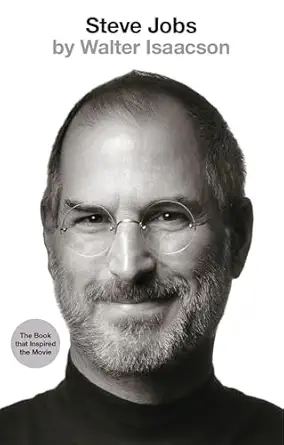
Steve Jobs
By Walter Isaacson
Core Book Summary
Steve Jobs by Walter Isaacson is the definitive, authorized biography of the creative entrepreneur whose passion for perfection and ferocious drive revolutionized six industries: personal computers, animated movies, music, phones, tablet computing, and digital publishing. Isaacson conducted over forty interviews with Jobs over two years, as well as interviews with more than a hundred family members, friends, adversaries, competitors, and colleagues. The result is a raw, unvarnished portrait of a complicated genius who could be simultaneously deeply inspiring and brutally cruel. At the center of Jobs' personality was his intense need for control and his binary view of the world. To Jobs, a product was either 'insanely great' or it was 'total shit'. An employee was either a 'genius' or a 'bozo'. This absolute perfectionism drove Apple to create products with unparalleled design and user experience. Jobs firmly believed in the end-to-end integration of hardware and software. While companies like Microsoft licensed their software to anyone (an open system), Jobs insisted that Apple control everything from the silicon to the operating system to the glass screen. He believed that the only way to ensure a seamless, magical user experience was to take responsibility for the entire product. The book famously details Jobs' 'Reality Distortion Field' (RDF). This was his uncanny ability to convince himself and everyone around him that the impossible was, in fact, possible. Through a mix of charm, charisma, and sheer unyielding will, Jobs would force engineers to meet impossible deadlines and achieve technical feats they previously thought were bound by the laws of physics. While the RDF often resulted in emotional burnout for his team, it was the exact catalyst needed to build the Mac, the iPod, and the iPhone. Isaacson also does not shy away from Jobs' dark side. His brutal honesty often crossed the line into emotional abuse. He regularly humiliated employees, took credit for others' ideas, and denied paternity of his first daughter for years. Yet, the biography argues that his personality and his products were deeply intertwined. His drive for perfection, born out of an intense inner restlessness, left no room for compromise. After being ousted from Apple in 1985, he matured (slightly) through his ventures with NeXT and Pixar, setting the stage for his triumphant return in 1997 to save Apple from bankruptcy. Ultimately, Steve Jobs is a masterclass in the intersection of the humanities and the sciences. Jobs proved that true innovation happens when artistic design meets cutting-edge engineering.
Key Takeaways
- The Reality Distortion Field: Jobs had a terrifying and awe-inspiring ability to bend reality to his will. Through sheer force of personality, he could convince teams to achieve the impossible on impossible deadlines.
- End-to-End Control: Unlike Microsoft's open ecosystem, Jobs insisted on a closed ecosystem. Apple had to control the hardware, the software, and the user interface to ensure a seamless, perfect user experience.
- Simplicity is the Ultimate Sophistication: Jobs stripped away everything unnecessary. He hated buttons, manuals, and complex interfaces. His obsession with minimalist design made Apple products feel intuitive and magical.
- Intersection of Humanities and Sciences: Jobs believed that technology alone is not enough. Apple's unique advantage was marrying hard engineering with art, design, and intuition.
- Perfectionism Over Profit: Jobs would routinely delay product launches or scrap entirely finished designs if they weren't 'insanely great'. He prioritized building a legendary product; he trusted the profits would follow.
- The Binary View of the World: To Jobs, things were either the best ever made, or they were garbage. People were either geniuses or bozos. This extreme standard pushed his teams to unparalleled heights, but also caused immense stress.
- A Players Only: Jobs believed that a small team of 'A+ players' could run circles around a giant team of 'B and C players'. He was ruthless about firing mediocrity to protect the concentration of talent.
- Brutal Honesty: Jobs was famously rude and abrasive. He believed that 'politeness' just allowed bad ideas to survive. He thought it was his duty as a leader to tell people exactly when their work was terrible.
- Connecting the Dots: Jobs' early interest in seemingly useless things (like a calligraphy class in college) perfectly translated into the beautiful typography of the first Mac years later. You must trust your curiosities.
- Focus Means Saying No: When Jobs returned to Apple in 1997, he slashed the product line from dozens of messy models down to just four. Deciding what NOT to do is as important as deciding what to do.