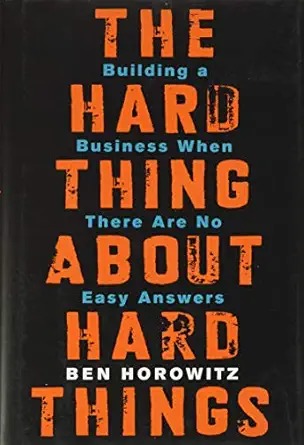
The Hard Thing About Hard Things
By Ben Horowitz
Core Book Summary
The Hard Thing About Hard Things by Ben Horowitz is arguably the most realistic, unvarnished, and brutally honest book ever written about running a startup. While most business books focus on the 'fun' parts of entrepreneurship (having a brilliant idea, creating a great culture, raising capital), Horowitz focuses entirely on the terrifying reality of what happens when everything goes catastrophically wrong. The core premise of the book is simple: The hard thing isn't setting a big, hairy, audacious goal. The hard thing is laying off people when you miss the big goal. The hard thing isn't dreaming big. The hard thing is waking up in the middle of the night in a cold sweat when the dream turns into a nightmare. Horowitz draws heavily from his own harrowing experiences as the CEO of Opsware, a company that constantly teetered on the edge of complete bankruptcy, survived the dot-com crash, and was eventually sold to HP for $1.6 billion. He explains that there is no perfect formula or secret recipe for navigating the abyss of a failing company. Being a CEO requires making agonizing decisions where there are no good options—only bad options and worse options. A central concept in the book is the stark difference between a 'Peacetime CEO' and a 'Wartime CEO'. A Peacetime CEO leads a company that has a large advantage over the competition in a growing market. They focus on expanding the market, encouraging creativity, and building a comfortable culture (think Google). A Wartime CEO, however, leads a company facing an existential threat. They must be utterly ruthless, micromanage if necessary, demand absolute compliance, and execute with lethal precision (think Andy Grove at Intel). Horowitz argues that the management styles are completely opposite, and very few leaders can successfully transition from one to the other. The book also tackles the emotional and psychological toll of leadership. Horowitz speaks candidly about 'The Struggle'—the period when you wonder why you even started the company, when your employees think you are lying, and when you feel completely isolated. To survive 'The Struggle', a CEO must not take things personally, must build an inner circle of truth-tellers, and must focus entirely on the next move. Furthermore, Horowitz gives incredibly specific advice on the dirtiest parts of management: how to fire a loyal friend, how to demote an executive, and how to tell your company that things are falling apart without causing a mass panic. Ultimately, the book is a survival manual for leaders standing on the edge of failure, teaching them how to endure the pain, face the truth, and keep fighting.
Key Takeaways
- There is No Formula: The hard thing about hard things is that there is no recipe for dealing with them. There is no formula for firing your best friend or saving a company from bankruptcy.
- The Struggle is Real: Every entrepreneur will face 'The Struggle'—the terrifying abyss where nothing is working and everyone expects you to fail. Surviving this psychological torment is the true test of a CEO.
- Peacetime vs. Wartime CEO: A Peacetime CEO focuses on culture, broad expansion, and creativity. A Wartime CEO focuses on immediate survival, strict compliance, and ruthless execution. You must know which one you need to be.
- Tell It Like It Is: Don't hide the bad news from your team to 'protect' them. Transparency builds trust. If the company is bleeding cash, tell the people who can actually help fix the problem.
- Take Care of the People, the Products, and the Profits (In That Order): If you don't take care of your people, the product will suffer. If the product suffers, the profits will disappear. People always come first.
- How to Fire Someone: Firing people is agonizing but necessary. Do it quickly, do it fairly, and do it yourself. Never humiliate the person, and ensure the rest of the company understands why it happened.
- Hire for Strength, Not Lack of Weakness: When hiring executives, don't look for someone who is 'okay' at everything (no weaknesses). Hire someone who is absolutely world-class at the one specific thing you desperately need right now.
- Train Your People: Good CEOs realize that training employees is not a luxury; it is a necessity. If you don't train your people, you have no right to be angry when they underperform.
- Don't Dodge the Hard Choices: As a leader, you will often have to choose between two terrible options. You cannot avoid the decision. You must make the hard choice and take absolute responsibility for the fallout.
- Focus on the Road, Not the Wall: When race car drivers spin out, if they look at the wall, they hit the wall. They must focus on the road. When your company is crashing, stop looking at the failure and focus entirely on the next correct move.