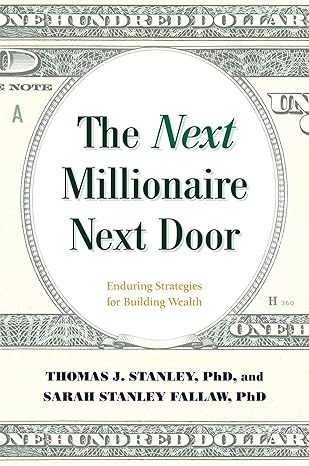
The Millionaire Next Door
By Thomas J. Stanley & William D. Danko
Core Book Summary
The Millionaire Next Door by Thomas J. Stanley and William D. Danko is a groundbreaking book that shatters the widespread myths and illusions about how true wealth is accumulated in America. Based on more than two decades of rigorous statistical research, comprehensive surveys, and in-depth interviews with actual millionaires, the authors reveal a surprising truth: most millionaires do not live in Beverly Hills, drive flashy exotic cars, or wear expensive designer clothes. Instead, the typical millionaire is often the person living right next door—a blue-collar business owner, a teacher, or an engineer who has quietly and methodically accumulated wealth over a lifetime of discipline. The book draws a stark contrast between two types of people: PAWs (Prodigious Accumulators of Wealth) and UAWs (Under Accumulators of Wealth). UAWs are often high-income earners who spend everything they make on status symbols to look rich, ultimately possessing very little actual net worth. PAWs, on the other hand, are masterful at creating wealth because they prioritize financial independence over social status. The core thesis of the book is that wealth is not the same as income. If you make a million dollars a year and spend a million dollars a year, you are not getting wealthier; you are just living a high-consumption lifestyle. True wealth is what you accumulate, not what you spend. The authors outline seven common denominators among those who successfully build wealth. Foremost among these is the principle of living well below your means. The self-made rich are meticulous budgeters who know exactly how much they spend on groceries, clothing, and housing. They invest heavily in stocks, private businesses, and real estate, allowing compounding interest to work in their favor over decades. Furthermore, they are frugal in almost every aspect of their lives—buying used cars rather than new ones, negotiating aggressively, and avoiding high-interest consumer debt like the plague. Another crucial aspect discussed in the book is the concept of 'Economic Outpatient Care' (EOC). The authors found that parents who heavily subsidize their adult children's lifestyles actually cripple their children's ability to build their own wealth. The most successful millionaires raise self-sufficient children by emphasizing education, hard work, and financial independence rather than providing endless financial bailouts. The book serves as a powerful wake-up call to anyone trapped in the cycle of consumerism. It proves mathematically and logically that anyone with a steady income can achieve millionaire status by adopting a lifestyle of intense frugality, aggressive saving, and long-term investing. The Millionaire Next Door is not a get-rich-quick scheme; it is a meticulously documented blueprint for building generational wealth through patience, discipline, and a complete disregard for keeping up with the Joneses.
Key Takeaways
- Live Below Your Means: This is the golden rule of wealth accumulation. The foundation of becoming a millionaire is consistently spending significantly less than you earn and saving the rest.
- Wealth vs. Income: High income does not equal high wealth. Many high earners are essentially broke because they spend everything to maintain a luxurious lifestyle, while average earners can become rich through saving.
- Time, Energy, and Money Allocation: PAWs (Prodigious Accumulators of Wealth) allocate their time, energy, and money efficiently, targeting wealth building through budgeting, planning, and investing rather than consuming.
- Financial Independence Over Status: True millionaires care more about achieving total financial freedom than displaying high social status. They prefer a fat bank account over a flashy new car.
- Avoid Economic Outpatient Care (EOC): Giving adult children too much financial support weakens their ambition and ability to generate their own wealth. Self-made millionaires raise financially independent children.
- Target Market Opportunities: The wealthy are highly proficient in targeting market opportunities. They often run businesses or provide services that cater to the affluent, such as accounting, law, or specialized contracting.
- Choose the Right Occupation: Many millionaires are self-employed professionals or business owners in 'dull' but highly profitable industries like plumbing, pest control, or mobile home parks.
- Frugality is Key: Wealthy individuals are extremely frugal. They buy used cars, live in modest homes, clip coupons, and rarely buy expensive suits or watches.
- Invest for the Long Term: Millionaires invest a minimum of 20% of their realized household income each year. They buy and hold investments for decades rather than trying to time the market.
- Stealth Wealth: The truly wealthy often look completely average. By avoiding the pressure to 'look rich,' they avoid the massive tax and lifestyle burdens that prevent average people from accumulating actual wealth.