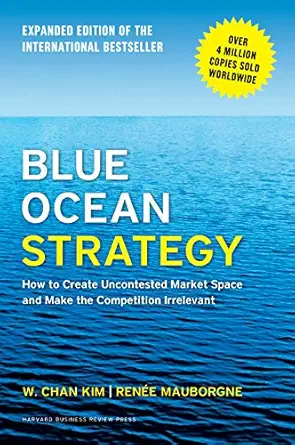
Blue Ocean Strategy
By W.C. Kim & R. Mauborgne
Core Book Summary
Blue Ocean Strategy by W. Chan Kim and Renée Mauborgne represents a paradigm shift in how companies should approach market competition. The authors argue that most businesses operate in 'Red Oceans'—existing, well-defined market spaces that are crowded with fierce competitors. In a Red Ocean, industry boundaries are defined and accepted, and the competitive rules of the game are known. Companies try to outperform their rivals to grab a greater share of existing demand. As the market space gets crowded, prospects for profits and growth are reduced. Products become commodities, and cutthroat competition turns the ocean 'bloody red'. The revolutionary alternative is to create 'Blue Oceans'—untapped, uncontested market spaces that create new demand and offer highly profitable growth. In a Blue Ocean, competition is entirely irrelevant because the rules of the game haven't been set yet. Instead of fighting over a shrinking pie, a Blue Ocean strategy focuses on creating a larger pie. The core mechanism to achieve this is 'Value Innovation'. Value innovation occurs when a company aligns innovation with utility, price, and cost positions. It fundamentally breaks the traditional value-cost trade-off (the belief that companies must choose between creating higher value at a higher cost or creating reasonable value at a lower cost). A successful Blue Ocean strategy pursues differentiation and low cost simultaneously. To help companies systematically create Blue Oceans, the authors introduce the 'Four Actions Framework'. To break the trade-off between differentiation and low cost, a company must ask four critical questions about the industry's strategic logic: 1) What factors that the industry takes for granted should be ELIMINATED? 2) What factors should be REDUCED well below the industry's standard? 3) What factors should be RAISED well above the industry's standard? 4) What factors should be CREATED that the industry has never offered? A classic example used in the book is Cirque du Soleil. Instead of competing with traditional circuses (a declining Red Ocean) by adding more expensive animal acts or star clowns, Cirque du Soleil ELIMINATED animals and star performers (dramatically lowering costs). They RAISED the artistic value and CREATED a sophisticated, theater-like environment with a storyline and original music. By doing so, they created an entirely new market space (a Blue Ocean) that appealed to adults and corporate clients who were willing to pay Broadway-level ticket prices. Blue Ocean Strategy proves that the best way to beat the competition is to stop trying to beat the competition.
Key Takeaways
- Red Oceans vs. Blue Oceans: Red Oceans are existing markets crowded with competitors fighting over the same customers. Blue Oceans are uncontested, new market spaces where competition is completely irrelevant.
- Make Competition Irrelevant: The goal of a Blue Ocean Strategy is not to defeat your rivals in an existing market, but to invent an entirely new market space where there are no rivals at all.
- Value Innovation: This is the cornerstone of Blue Ocean Strategy. It is the simultaneous pursuit of high differentiation and low cost, creating a leap in value for both the buyer and the company.
- Break the Value-Cost Trade-Off: Traditional strategy says you can either offer premium value at a high cost, or average value at a low cost. Blue Oceans break this rule by doing both at the same time.
- The Four Actions Framework: To create a Blue Ocean, ask four questions: What can be Eliminated? What can be Reduced? What can be Raised? What can be Created?
- Stop Looking at Competitors: If you obsess over your competitors, your product will end up looking exactly like theirs. Look at alternatives and non-customers to find inspiration for new demand.
- Target 'Non-Customers': Red Ocean companies fight over existing customers. Blue Ocean companies look at the people who *refuse* to use the industry's products and figure out how to convert them into buyers.
- Eliminate Industry Standards: Many costs in an industry exist simply out of tradition (e.g., animals in a circus). Eliminating these deeply ingrained but unnecessary factors dramatically lowers your costs.
- Focus on the Big Picture, Not the Numbers: When planning strategy, draw a 'Strategy Canvas' to visually map out where you stand compared to others, rather than getting lost in spreadsheets and financial projections.
- Execution Requires Overcoming Hurdles: Executing a Blue Ocean Strategy requires overcoming organizational hurdles: waking employees up to the need for change, managing limited resources, and overcoming office politics.