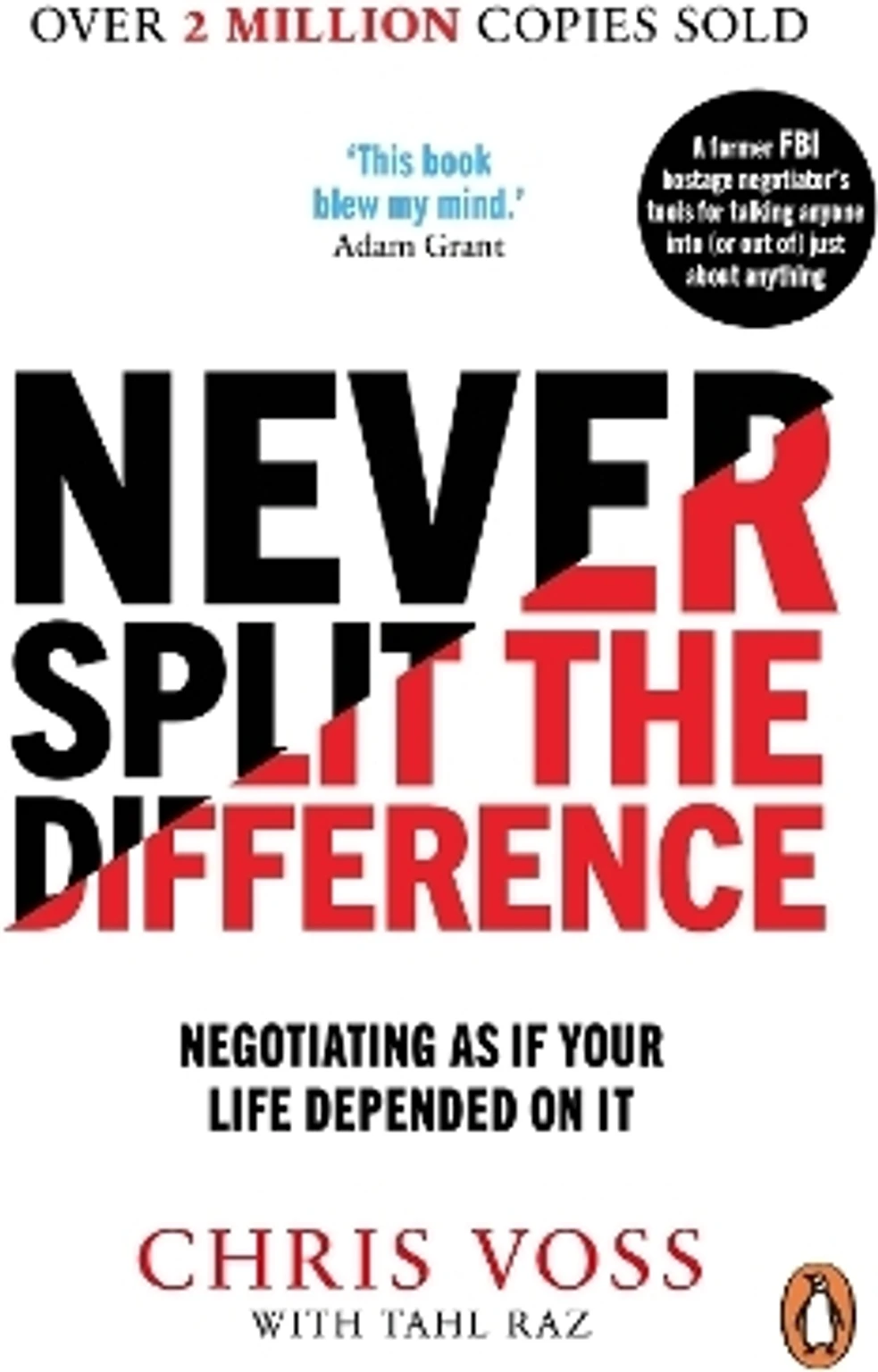
Never Split the Difference: Negotiating As If Your Life Depended On It
By Chris Voss
Core Book Summary
Never Split the Difference by Chris Voss, a former lead international kidnapping negotiator for the FBI, offers a gripping, field-tested approach to high-stakes negotiations, whether in the boardroom or in everyday life. Voss challenges the traditional, logical approaches to negotiation taught in business schools, arguing that human beings are deeply emotional and irrational creatures. The book reveals that successful negotiation is not about a rigid mathematical formula or aggressively demanding your way, but rather about tactical empathy—deeply understanding the psychological and emotional state of your counterpart. By mastering the art of active listening, making the other person feel heard, and uncovering their hidden needs, you can defuse conflict and build solid trust. Instead of 'splitting the difference,' which often leaves both parties dissatisfied and creates mediocre compromises, Voss teaches readers how to use specific communication techniques to shape the negotiation landscape. He introduces powerful tools like 'mirroring' (repeating the last three words of what someone said), labeling emotions to neutralize negativity, and utilizing the power of getting a 'No' to make the counterpart feel safe and in control. Ultimately, the book provides a highly practical framework for anyone looking to improve their persuasion skills, negotiate a better salary, buy a home, or simply communicate more effectively in their personal relationships without alienating the other person.
Key Takeaways
- Tactical Empathy: Negotiation is not a battle of logic, but an exercise in emotional intelligence and tactical empathy, where you deeply understand the counterpart's feelings and mindset.
- Mirroring: A simple but highly effective technique involves repeating the last three words (or the most critical one to three words) of what your counterpart just said to build rapport and encourage them to reveal more.
- Labeling: Validate the other person's emotions by labeling them out loud (e.g., 'It seems like you are frustrated'). This helps defuse negative feelings and builds trust quickly.
- The Power of 'No': Contrary to popular belief, pushing for a 'Yes' can make people defensive. Giving them the permission to say 'No' makes them feel safe, in control, and more open to negotiation.
- Triggering 'That's Right': Aim to summarize the other person's position so well that they have no choice but to say, 'That's right.' This signals a massive breakthrough in mutual understanding.
- Beware of 'Yes': There are three kinds of 'Yes': Counterfeit, Confirmation, and Commitment. Learn to distinguish them to avoid being strung along by a fake agreement.
- Calibrated Questions: Replace direct demands with open-ended 'How' and 'What' questions (e.g., 'How am I supposed to do that?'). This forces the other side to use their mental energy to solve your problem.
- Bending Reality: Use anchoring, deadlines, and the concept of fairness to your advantage. People will often accept a deal if they feel they are being treated fairly and fear losing out on an opportunity.
- Bargaining Hard: Prepare for the actual haggling phase using the Ackerman model, starting with a lowball offer and gradually making decreasing increments to signal you are at your absolute limit.
- Finding the Black Swan: In every negotiation, there are hidden pieces of information (Black Swans) that, if uncovered, can completely change the dynamic of the deal. Keep digging and listening until you find them.