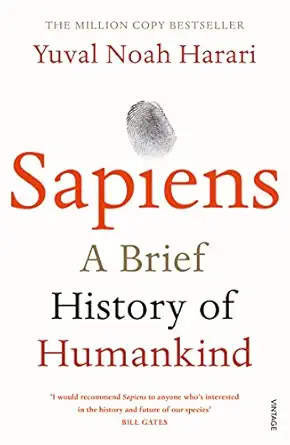
Sapiens: A Brief History of Humankind
By Yuval Noah Harari
Core Book Summary
Sapiens by Yuval Noah Harari is a breathtaking, sweeping narrative of human history that completely reshapes our understanding of how a marginal ape became the ruler of planet Earth. One hundred thousand years ago, at least six different species of humans inhabited the earth. Today, there is only one: Homo sapiens. How did we succeed where others failed? Harari argues that our dominance is not due to physical strength or individual intelligence, but our unique ability to cooperate in large, flexible numbers. And the secret to that mass cooperation is our unique ability to believe in shared fictions. The book is divided into three major revolutions that shaped human destiny. First, the 'Cognitive Revolution' (70,000 years ago) gave Sapiens the ability to communicate about things that do not exist physically. Harari controversially points out that human rights, religions, money, laws, and corporations are all just 'myths' or fictions created by human imagination. Because millions of people believe in the fiction of 'money' or 'nations', they can cooperate effectively. A chimpanzee cannot be convinced to give you a banana today in exchange for limitless bananas in heaven; only Sapiens can believe such stories. Next came the 'Agricultural Revolution' (12,000 years ago), which Harari provocatively calls 'history's biggest fraud.' While it allowed the human population to explode, it made the lives of individual farmers much harder, more disease-prone, and more diet-restricted than those of their hunter-gatherer ancestors. We didn't domesticate wheat; wheat domesticated us. The Agricultural Revolution also brought about the concepts of property, hierarchy, and inequality, leading to the rise of kingdoms, empires, and strict social structures. Finally, the 'Scientific Revolution' (begun 500 years ago) triggered unprecedented growth. Harari explains that this revolution was not driven by the sudden emergence of brilliance, but by the 'discovery of ignorance'—humanity's willingness to admit that it didn't know everything, coupled with the desire to acquire new powers through observation and mathematics. This led to the marriage of science and capitalism, where European powers conquered the globe in search of new knowledge and new markets. The book concludes by asking terrifying yet essential questions about our future: as we merge with AI and biotechnology, creating non-organic life, are we approaching the end of Homo sapiens? Sapiens is not just a history book; it is a profound philosophical inquiry into what it means to be human.
Key Takeaways
- The Power of Fiction: Homo sapiens dominate the world because we can cooperate in large numbers. This cooperation is possible because we can invent and believe in shared fictions (religion, money, corporations, laws).
- Money is the Ultimate Trust System: Money has no objective value. It is simply the most universal and efficient system of mutual trust ever created. Even enemies who hate each other's religion will agree on the value of gold or dollars.
- The Agricultural Fraud: Farming allowed populations to grow, but it drastically reduced the quality of life for the average person compared to their hunter-gatherer ancestors. Wheat domesticated humans, not the other way around.
- The Discovery of Ignorance: The Scientific Revolution was sparked when humans finally admitted, 'We don't know the answers.' This willingness to admit ignorance drove the relentless pursuit of new knowledge and technology.
- Empire and Science: European empires conquered the world not just for wealth, but for knowledge. The alliance between science and imperialism is what gave Europe its immense global dominance over the last 500 years.
- Capitalism as a Religion: Capitalism isn't just an economic theory; it functions like a religion. Its core belief is that economic growth is the supreme good and that profits must continually be reinvested to increase production.
- The Cost of Comfort: As our power and technology have grown exponentially, our individual happiness has not necessarily followed suit. We are more powerful than ever, but often more alienated and anxious.
- Biology is Dictatorship: Throughout history, human societies have been strictly organized by biological myths (racism, sexism, castes). Biology enables everything; it is human culture that forbids things by creating rules.
- The Unification of Humankind: Over thousands of years, smaller cultures have continually merged into larger civilizations. Today, despite political borders, humanity essentially shares a single global culture and economic system.
- The End of Sapiens: We are on the verge of becoming 'gods' through artificial intelligence and biotechnology. We will soon be able to design life itself, which may ultimately mean the end of Homo sapiens as we know them.