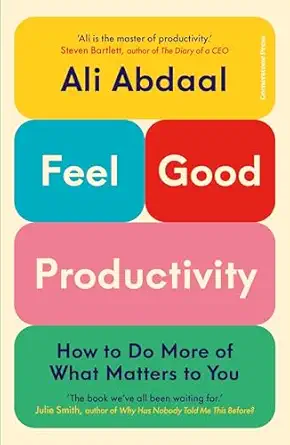
Feel-Good Productivity
By Ali Abdaal
Core Book Summary
Feel-Good Productivity by Dr. Ali Abdaal fundamentally challenges the traditional hustle culture narrative that dictates success must come through grinding, suffering, and relentless discipline. Drawing on psychology, neuroscience, and his own experiences working as a doctor while building a massive YouTube channel, Abdaal argues that the secret to sustainable productivity is not forcing yourself to do things you hate, but rather finding ways to make the work feel genuinely good. When we experience positive emotions, our brains release dopamine and endorphins, which actually broaden our cognitive focus, boost our energy, and increase our resilience. The core thesis is simple: success doesn't lead to feeling good; feeling good leads to success. The book is structured around a three-part framework: Energize, Unblock, and Sustain. The first part, 'Energize,' focuses on introducing positive emotions into your daily tasks to overcome the initial hurdle of getting started. Abdaal introduces the concepts of Play, Power, and People. By treating tasks as a game (Play), taking ownership and aligning work with your core strengths (Power), and collaborating or connecting with others (People), you generate intrinsic motivation that eliminates the need for brute-force willpower. The second part, 'Unblock,' deals with procrastination. Abdaal explains that procrastination is rarely a time-management issue; it is an emotional regulation issue. We procrastinate because we feel uncertainty, fear, or friction. He provides practical strategies to clarify exactly what needs to be done, reduce the environmental friction, and lower the stakes so that fear doesn't paralyze us into inaction. The final part, 'Sustain,' addresses the critical issue of burnout. Traditional productivity advice often pushes people until they break, leading to physical and emotional exhaustion. Abdaal outlines three types of burnout: overexertion (doing too much), depletion (not resting enough), and misalignment (doing the wrong things). To combat this, he emphasizes the necessity of high-quality downtime—rest that actually replenishes your energy rather than just numbing your brain with social media. He also advocates for regular alignment checks to ensure that the work you are doing is actually moving you toward a life you value. Feel-Good Productivity is a warm, scientifically backed, and highly actionable guide that proves you can achieve extraordinary things without sacrificing your mental health or your happiness in the process.
Key Takeaways
- The Productivity Equation: Success does not create happiness; happiness creates success. When you feel good, your brain functions better, making you naturally more creative, energized, and productive.
- The Power of Play: Stop treating work like a grim duty. Gamify your tasks, find the fun in the process, and adopt a curious, playful mindset. Play is a massive generator of intrinsic motivation.
- Find Your Power (Autonomy): We are most energized when we feel in control of our actions. Take ownership of your projects and lean into your natural strengths rather than obsessing over your weaknesses.
- Connect with People: Humans are deeply social creatures. Working alongside others, even virtually, or feeling a sense of contribution to a team, provides a profound boost of energy and purpose.
- Procrastination is Emotional: You don't procrastinate because you are lazy; you procrastinate because a task triggers negative emotions like fear, confusion, or overwhelm. Fix the emotion to fix the delay.
- Reduce the Friction: Make it as easy as possible to start the right behaviors and as hard as possible to start bad ones. Lay out your gym clothes the night before; hide your phone in another room.
- Lower the Stakes: Perfectionism causes paralysis. Overcome fear by lowering the stakes. Tell yourself you are just writing a 'crappy first draft' or doing a 5-minute 'experiment' to remove the pressure.
- Identify Burnout Types: Understand that burnout comes in three forms: Overexertion (taking on too much volume), Depletion (failing to recharge your batteries), and Misalignment (doing work that clashes with your values).
- Recharge with High-Quality Rest: Scrolling through Instagram on the couch is not restful. True downtime should actively replenish you—like taking a walk in nature, engaging in a creative hobby, or sleeping deeply.
- The Alignment Check: Regularly step back and ask yourself if the ladder you are climbing is leaning against the right wall. Productivity is useless if you are efficiently moving in the wrong direction.