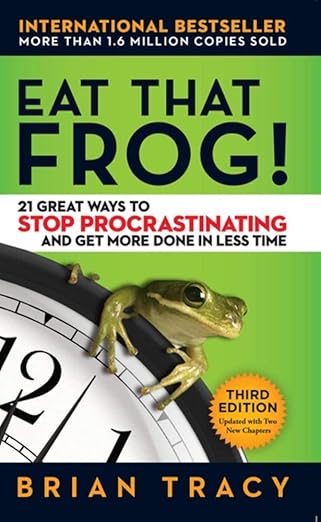
Eat That Frog!
By Brian Tracy
Core Book Summary
Eat That Frog! by Brian Tracy is a highly acclaimed productivity and time-management manifesto designed to help people overcome procrastination and get more of the important things done in less time. The title is inspired by a famous Mark Twain quote: 'If it's your job to eat a frog, it's best to do it first thing in the morning. And if it's your job to eat two frogs, it's best to eat the biggest one first.' In Tracy's methodology, your 'frog' is your biggest, most important task—the one you are most likely to procrastinate on if you don't do something about it. It is also the task that can have the greatest positive impact on your life and career. The book operates on the premise that you can never do everything on your to-do list, so you must learn to prioritize ruthlessly and tackle the high-impact items first. A core theme of the book is the absolute necessity of clarity and planning. Tracy argues that a significant reason for procrastination is confusion about what needs to be done and in what order. He strongly advocates for thinking on paper. By writing down your goals and breaking them into actionable steps, you immediately increase your chances of success. Furthermore, he emphasizes the 80/20 Rule (the Pareto Principle), which states that 20 percent of your activities will account for 80 percent of your results. Your job as a professional is to identify those top 20 percent tasks (your frogs) and refuse to work on the bottom 80 percent while the most important tasks remain undone. To aid in this rigorous prioritization, Tracy introduces the ABCDE Method. This is a powerful, daily priority-setting technique. 'A' tasks are things you absolutely must do—the frogs that have serious consequences if left undone. 'B' tasks are things you should do, but have only mild consequences. 'C' tasks are nice to do, 'D' tasks can and should be delegated to someone else, and 'E' tasks should be eliminated entirely because they don't matter anymore. The golden rule of this system is to never start a 'B' task when an 'A' task is left unfinished. By organizing your daily list with this method, you ensure that your focus remains locked on the activities that truly move the needle. Finally, the book deals with the mechanics of execution. Tracy explains the Law of Forced Efficiency, which states that there is never enough time to do everything, but there is always enough time to do the most important thing. He urges readers to practice 'single-handling'—the act of picking up a task, working on it continuously without distraction, and staying with it until it is 100 percent complete. By combining crystal-clear goals, ruthless prioritization, and disciplined, uninterrupted execution, Eat That Frog! provides a comprehensive system for anyone looking to maximize their productivity, reduce stress, and achieve rapid success in any area of life.
Key Takeaways
- Set the Table: Decide exactly what you want. Clarity is the most important concept in personal productivity. Always think on paper.
- Plan Every Day in Advance: Your mind is for having ideas, not holding them. Write down your tasks for the next day every night so your subconscious can work on them while you sleep.
- Apply the 80/20 Rule: 20% of your activities account for 80% of your results. Always concentrate your efforts on that top 20% (your frogs).
- Consider the Consequences: Your most important tasks and priorities are those that can have the most serious consequences, positive or negative, on your life or work.
- Practice the ABCDE Method: Before you begin working on a list of tasks, categorize them from A (must do) to E (eliminate) to ensure you are working on the most valuable items.
- Focus on Key Result Areas: Identify the most critical results you absolutely must get to do your job well, and work on them all day long.
- Obey the Law of Forced Efficiency: There is never enough time to do everything, but there is always enough time to do the most important thing. You cannot do it all.
- Prepare Thoroughly Before You Begin: Clear your workspace and gather all the resources, information, and tools you need before you start so you don't have to interrupt your workflow.
- Take It One Oil Barrel at a Time: You can accomplish the biggest and most complicated job if you just complete it one small step at a time.
- Single Handle Every Task: Set clear priorities, start immediately on your most important task, and work without stopping until the job is 100% complete. This is the real key to high performance.