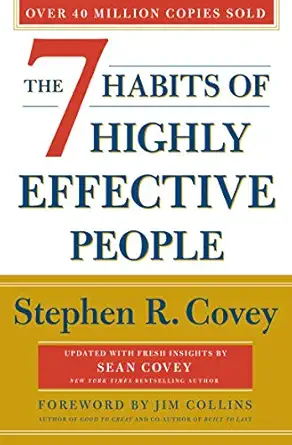
The 7 Habits of Highly Effective People
By Stephen R. Covey
Core Book Summary
The 7 Habits of Highly Effective People by Stephen R. Covey is arguably the most influential self-improvement book of modern times. Unlike many self-help books that focus on quick fixes, 'personality ethics', or manipulative techniques, Covey's masterpiece is rooted in 'Character Ethics'—timeless principles like fairness, integrity, honesty, and human dignity. Covey asserts that true success is built from the inside out. Before we can change our circumstances, we must change ourselves, and to change ourselves, we must change our paradigms—the fundamental lenses through which we see the world. The book is structured as a progression from dependence to independence (Private Victory), and then from independence to interdependence (Public Victory). The first three habits focus on self-mastery and the 'Private Victory'. Habit 1: 'Be Proactive' teaches that we are not the product of our circumstances, but of our decisions. We have the freedom to choose our response to any stimulus. Habit 2: 'Begin with the End in Mind' urges readers to define their core values and ultimate life goals (even imagining their own funeral) before taking action, ensuring the ladder is leaning against the right wall. Habit 3: 'Put First Things First' is the practical execution of Habit 2, focusing on time management that prioritizes what is truly important over what is merely urgent. Once self-mastery is achieved, the next three habits move to the 'Public Victory'—mastering relationships and teamwork. Habit 4: 'Think Win-Win' is an attitude that constantly seeks mutual benefit in all human interactions, moving away from zero-sum competition. Habit 5: 'Seek First to Understand, Then to Be Understood' is about empathetic listening. Most people listen with the intent to reply, not to understand. True influence begins with deep, genuine listening. Habit 6: 'Synergize' is the habit of creative cooperation, where a group produces something greater than the sum of its parts (1+1=3). Finally, Habit 7: 'Sharpen the Saw' encompasses all the other habits. It is the habit of continuous self-renewal across four dimensions of life: Physical (exercise, nutrition), Mental (reading, learning), Emotional/Social (service, relationships), and Spiritual (meditation, value clarification). Covey's 7 Habits is not a list of quick tips; it is a profound, lifelong framework for developing a solid character, fostering healthy relationships, and achieving sustainable, holistic effectiveness in all areas of life.
Key Takeaways
- Paradigm Shift: If you want small changes, work on your behavior. If you want quantum-leap changes, work on your paradigms—the fundamental way you perceive the world and your problems.
- Habit 1 - Be Proactive: You are the creator of your life. Do not blame genetics, circumstances, or other people. Focus your energy on your 'Circle of Influence' (what you can control) rather than your 'Circle of Concern'.
- Habit 2 - Begin with the End in Mind: All things are created twice: first mentally, then physically. Create a personal mission statement and know exactly what you want to achieve before you start acting.
- Habit 3 - Put First Things First: Effective people focus on tasks that are 'Important but Not Urgent' (like exercise, planning, relationship building). Don't let the urgent, noisy tasks dictate your life.
- Independence to Interdependence: You cannot successfully work with others (Interdependence) until you have mastered yourself (Independence). Private victories must precede public victories.
- Habit 4 - Think Win-Win: Life is not a zero-sum game. You don't have to crush someone else to succeed. Always look for solutions where both parties walk away feeling satisfied and valued.
- Habit 5 - Seek First to Understand, Then to Be Understood: The most crucial communication skill is empathetic listening. Stop formulating your reply while the other person is talking. Truly listen to understand their world.
- Habit 6 - Synergize: Synergy happens when people work together to create a solution that is better than what either could have created alone. Value differences in opinion as an opportunity for synergy.
- Habit 7 - Sharpen the Saw: You must continuously renew yourself. If you are too busy sawing to sharpen your saw, you will burn out. Dedicate time to physical, mental, emotional, and spiritual renewal.
- Character Ethic over Personality Ethic: Quick fixes and communication 'tricks' do not create lasting success. Long-term effectiveness requires building a deep, unshakeable character based on timeless principles.