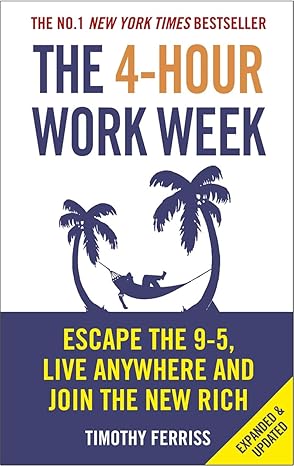
The 4-Hour Workweek
By Timothy Ferriss
Core Book Summary
The 4-Hour Workweek by Timothy Ferriss is a groundbreaking manual for escaping the traditional 9-to-5 grind and designing a life of ultimate freedom and mobility. Ferriss introduces the concept of the 'New Rich' (NR)—people who abandon the deferred-life plan (working endlessly until retirement) and instead create luxury lifestyles in the present using the currencies of time and mobility. The book completely dismantles the conventional wisdom that you have to work 40-plus hours a week for 40 years to be successful. Instead, Ferriss provides a step-by-step blueprint, encapsulated in the acronym DEAL: Definition, Elimination, Automation, and Liberation. He argues that being busy is often a form of laziness—lazy thinking and indiscriminate action. True productivity is about achieving maximum output with minimum effort and time. The first step, Definition, flips traditional goal-setting on its head. Ferriss encourages calculating the exact daily cost of your dream lifestyle—which is usually much less than a million dollars—and aiming for that specific number. The second step, Elimination, is deeply rooted in time management principles like the Pareto Principle (80/20 rule) and Parkinson's Law (work expands to fill the time available). Ferriss ruthlessly advocates for an 'information diet,' checking emails only once a week, and completely eliminating tasks that do not directly contribute to the bottom line. The Automation phase teaches readers how to put their income on autopilot by outsourcing life and business tasks to virtual assistants (VAs) in countries with favorable exchange rates, and by creating automated dropshipping or digital product businesses. Finally, Liberation is about breaking the physical tethers to a single location. Ferriss provides scripts and strategies to negotiate remote work with employers, allowing you to travel the world, take 'mini-retirements,' and live like a millionaire without actually needing to have millions in the bank. The 4-Hour Workweek is not just a book about working less; it is a profound philosophical shift about questioning societal norms, eliminating the unnecessary, and prioritizing life experiences over mindless accumulation of wealth and stress.
Key Takeaways
- The New Rich (NR): Shift your goal from accumulating a massive retirement fund to creating a lifestyle of time and mobility right now. The NR prioritize freedom over a high, fixed salary.
- The 80/20 Rule (Pareto Principle): Identify the 20% of your efforts that produce 80% of your results. Focus exclusively on those high-yield activities and drop or delegate the rest.
- Parkinson's Law: Work expands to fill the time allotted for its completion. If you give yourself 8 hours to do a task, it takes 8 hours. Give yourself 2 hours, and you will miraculously finish it in 2.
- The Low-Information Diet: Stop consuming endless news, social media, and unnecessary data. Ignorance is practically a prerequisite for deep focus and high productivity.
- Batching Tasks: Group similar, repetitive tasks together and do them all at once at scheduled intervals (like answering emails only at 12 PM and 4 PM) to avoid constant context-switching.
- Outsource Your Life: You don't need to be a CEO to have an assistant. Hire Virtual Assistants (VAs) to handle repetitive administrative tasks, freeing up your time for high-value strategic work.
- Mini-Retirements: Don't wait until you are 65 to enjoy life. Distribute 'mini-retirements' (1-6 months of travel or passion projects) throughout your working years.
- Relative Income vs. Absolute Income: Earning $100,000 a year working 80 hours a week in an expensive city makes you poorer in 'relative income' than someone earning $50,000 working 10 hours a week in a low-cost country.
- Eliminate the Unimportant: Doing something unimportant well does not make it important. If a task doesn't move the needle, don't do it at all. Elimination is always better than optimization.
- Overcome the Fear of the Unknown: Define your worst-case scenario. When you actually write down the absolute worst thing that could happen if you quit your job or start a business, you'll realize it's completely reversible.