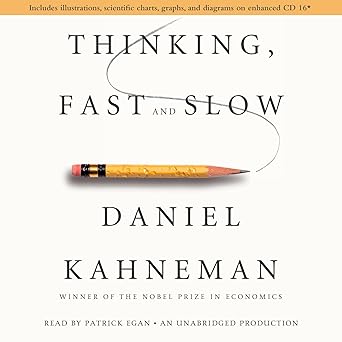
Thinking, Fast and Slow
By Daniel Kahneman
Core Book Summary
Thinking, Fast and Slow is a monumental book by Nobel laureate Daniel Kahneman that takes us on a groundbreaking tour of the human mind. The book explains the two systems that drive the way we think and make decisions. System 1 is fast, intuitive, automatic, and emotional. It operates effortlessly and requires no conscious control (e.g., jumping when you hear a loud noise or reading a billboard on the highway). System 2 is slow, deliberate, analytical, and logical. It requires focused attention and mental effort (e.g., solving a complex math problem or parallel parking in a tight space). Kahneman explains that while System 2 believes it is in charge, it is actually lazy and mostly just endorses the rapid, instinctual suggestions provided by System 1. Because System 1 relies on shortcuts (heuristics) to make rapid sense of the world, it is highly prone to systemic errors and cognitive biases. For example, the 'Halo Effect' makes us assume that because a person is physically attractive, they must also be intelligent and kind. The 'Availability Heuristic' makes us judge the probability of an event based on how easily an example comes to mind (which is why people fear plane crashes more than car crashes, even though the latter are statistically much more deadly). The book also deeply explores 'Loss Aversion'—the psychological principle that the pain of losing something is emotionally twice as powerful as the pleasure of gaining the equivalent thing. This explains why humans are generally risk-averse and often make irrational financial decisions just to avoid a perceived loss. Kahneman also introduces the concept of the 'Sunk Cost Fallacy', where people continue investing in a losing proposition (like a bad stock or a failing relationship) simply because they have already invested time or money into it. Furthermore, Kahneman distinguishes between the 'Experiencing Self' (the part of us that lives in the present moment) and the 'Remembering Self' (the part of us that keeps score and writes our life story). Surprisingly, our Remembering Self is largely influenced by how an experience ends and its peak emotional moments, while completely ignoring the duration of the experience. Ultimately, Thinking, Fast and Slow teaches us to recognize when our fast, intuitive System 1 is leading us into a trap, and when we need to purposefully engage our slow, analytical System 2 to make better personal, financial, and professional decisions.
Key Takeaways
- Two Systems of Thought: Our brain operates using two systems. System 1 is fast, automatic, and emotional. System 2 is slow, effortful, and logical. We rely on System 1 far more than we realize.
- System 2 is Lazy: Even though System 2 is capable of deep logic, it is inherently lazy. It often accepts the quick, biased conclusions handed to it by System 1 without verifying them.
- The Halo Effect: Our brain's tendency to let one positive trait of a person (like physical attractiveness) influence our judgment of their other traits (like intelligence or morality).
- Availability Heuristic: We judge the likelihood of events based on how easily they come to mind. Sensational news makes us over-worry about rare events (like shark attacks) and ignore common risks.
- Anchoring Effect: When making numerical decisions (like negotiating a price), our minds are heavily influenced by the first number mentioned, even if it is completely arbitrary.
- Loss Aversion: Humans feel the pain of a loss twice as strongly as the joy of an equivalent gain. This psychological trait makes us highly irrational when faced with financial risks.
- Sunk Cost Fallacy: We refuse to abandon a failing project, bad investment, or toxic relationship simply because we have already invested time, money, or emotion into it.
- Framing Effect: The way information is presented completely alters our decisions. We will accept a surgery with a '90% survival rate' but reject one with a '10% mortality rate', even though they are exactly the same.
- Overconfidence Bias: System 1 loves to jump to conclusions based on limited information (What You See Is All There Is). This creates an illusion of certainty and makes us overly confident in our flawed predictions.
- Experiencing vs. Remembering Self: We evaluate our past experiences based only on their most intense peak moments and how they ended, completely ignoring how long the experience actually lasted.