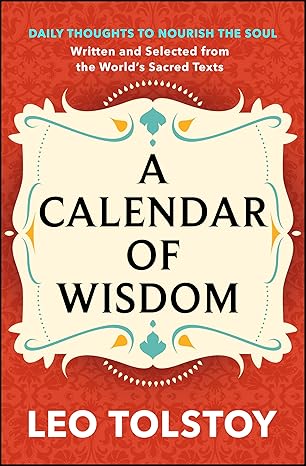
A Calendar of Wisdom
By Leo Tolstoy
Core Book Summary
A Calendar of Wisdom by Leo Tolstoy is a profound and meticulously curated collection of daily philosophical thoughts, spiritual reflections, and moral insights. Widely considered to be Tolstoy's final major work and his personal favorite, this book was born out of a deeply personal spiritual crisis that the legendary Russian author experienced later in his life. Turning away from the fiction that made him famous, Tolstoy spent over fifteen years compiling the wisdom of the world's greatest thinkers, filtering their ideas through his own evolving moral compass. The structure of the book provides a specific reading for every single day of the year, focusing on overarching themes such as truth, love, mortality, the nature of the soul, and the importance of living a life free from violence and materialism. Tolstoy did not simply write this book; he synthesized the thoughts of diverse philosophical giants including Epictetus, Marcus Aurelius, Lao-Tzu, Buddha, Confucius, Blaise Pascal, Arthur Schopenhauer, and Jesus Christ. The core message of A Calendar of Wisdom revolves around the pursuit of inner peace and the rejection of external, worldly validations. Tolstoy passionately argues that true happiness cannot be found in the accumulation of wealth, status, or power, but rather in the development of a strong inner spiritual life. He advocates for the principle of 'non-resistance to evil by force,' a concept that later heavily influenced historical figures like Mahatma Gandhi and Martin Luther King Jr. The daily readings encourage readers to practice immense humility, to forgive those who wrong them, and to recognize the inherent divine spark within every human being. Tolstoy emphasizes that our primary duty on Earth is to love one another and to continuously strive for personal moral perfection, regardless of the chaos in the external world. Furthermore, the book serves as a daily anchor in an increasingly distracted world. It calls upon the reader to live strictly in the present moment, reminding us that the past is unchangeable and the future is an illusion. By meditating on these curated thoughts each day, Tolstoy believed individuals could slowly strip away their ego and align themselves with a higher universal truth. The text acts as a timeless spiritual manual that strips away complex religious dogmas and focuses entirely on practical, lived morality. It is not meant to be read in a single sitting, but rather absorbed slowly, allowing each day's wisdom to take root in the reader's consciousness. In a modern era plagued by anxiety and materialistic endless pursuits, A Calendar of Wisdom remains an incredibly relevant and grounding masterpiece that demands quiet reflection and a genuine commitment to becoming a better human being.
Key Takeaways
- Live in the Present Moment: The only time over which we have true control is the present. Do not dwell on past regrets or anxiety about the future; focus entirely on acting morally and kindly right now.
- The Power of Universal Love: Love is the ultimate unifying force of humanity. True love is not just affection for your family or friends, but a deep, unselfish compassion for all living beings, including your enemies.
- Non-Resistance to Evil: Responding to violence or hatred with more violence only multiplies the evil in the world. True strength lies in breaking the cycle of anger by responding to malice with forgiveness and peaceful steadfastness.
- The Illusion of Material Wealth: Accumulating money, property, and physical luxuries will never lead to genuine happiness. These external things only distract us from the necessary work of inner spiritual development.
- Inner Truth over External Validation: Stop seeking the approval of society. Focus instead on listening to the quiet voice of your own conscience, which is your most reliable guide to a righteous life.
- The Equality of All Human Beings: Look past titles, wealth, and social classes. Recognize that the same divine spark exists equally in a peasant and a king, demanding that we treat everyone with absolute respect.
- Continuous Moral Improvement: Perfection may be unattainable, but the continuous, daily effort to overcome our own flaws, selfishness, and ego is the very purpose of human existence.
- The Inevitability of Death: Meditating on our own mortality is not meant to be depressing, but liberating. Keeping death in mind helps us prioritize what truly matters and trivializes petty arguments and selfish desires.
- Action Over Words: It is useless to simply talk about philosophy or religion. True wisdom is demonstrated through your daily actions, your habits, and how you treat those who can do nothing for you.
- The Necessity of Silence and Solitude: In a noisy world, regular periods of silence are essential. Solitude allows you to examine your thoughts honestly and connect with the spiritual realities that govern the universe.