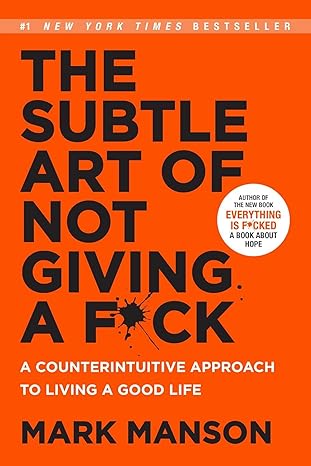
The Subtle Art of Not Giving a F*ck
By Mark Manson
Core Book Summary
The Subtle Art of Not Giving a F*ck by Mark Manson is a brilliant, counterintuitive approach to living a good life. In stark contrast to the modern self-help industry, which constantly pushes us to be happier, wealthier, smarter, and 'better' at all times, Manson argues that this endless pursuit of positivity is actually making us miserable. He calls this the 'Feedback Loop from Hell'—being anxious about being anxious, or feeling guilty for feeling sad. The core message of the book is not about being indifferent or apathetic to the world. Instead, 'not giving a f*ck' means being comfortable with being different and, more importantly, choosing exactly what you DO care about. Manson states that human beings have a limited amount of emotional energy. If you care about every trivial annoyance—the rude cashier, the traffic jam, the fact that your neighbor has a better car—you will drain your energy and live a miserable life. Maturity is the process of learning to care only about the things that truly matter: your family, your core values, your passions. Everything else should fall to the wayside. Another profound concept explored in the book is the value of suffering. Manson argues that life is essentially a series of problems. Happiness does not come from the absence of problems, but rather from the act of solving them. Therefore, the key to a good life is not avoiding struggle, but finding the struggles that you actually enjoy fighting. You have to ask yourself: 'What pain do I want in my life?' If you want to be a successful CEO, you have to enjoy the 80-hour workweeks and the stress. If you want a great physical body, you have to enjoy the pain of the gym and eating bland food. Manson also shatters the modern delusion of 'exceptionalism'. Society conditions us to believe that everyone is destined for greatness. The reality is that most of us are remarkably average at most things, and that is completely fine. Accepting our mediocrity frees us from the crushing pressure to constantly prove ourselves. Finally, the book emphasizes absolute responsibility. While you are not to blame for every tragedy that happens to you (like a disease or being robbed), you are 100% responsible for how you respond to it. Ultimately, The Subtle Art is a raw, honest guide to embracing our limitations, confronting painful truths, and focusing our limited time only on what genuinely holds meaning.
Key Takeaways
- The Feedback Loop from Hell: Our culture promotes constant toxic positivity. Getting angry that you are angry, or feeling sad about being sad, just multiplies your suffering. Accept your negative emotions.
- What Does It Mean to 'Not Give a F*ck'?: It does not mean being indifferent or apathetic. It means choosing what truly matters to you and not caring about the trivial nonsense or what others think about your choices.
- Happiness is Solving Problems: Life is a never-ending series of problems. True happiness is not the absence of problems; it is finding problems that you actually enjoy solving.
- Choose Your Struggle: Instead of asking 'What do I want out of life?', ask 'What pain do I want?'. Every success requires suffering. You must fall in love with the process and the pain associated with your goal.
- You Are Not Special: The modern obsession with being 'extraordinary' creates crippling anxiety. Accepting that you are mostly average takes the pressure off and allows you to enjoy simple, everyday life.
- The Value of Suffering: Growth only happens through pain and failure. Shielding yourself (or your children) from failure creates a fragile, entitled mindset. Embrace failure as a necessary stepping stone.
- Fault vs. Responsibility: Something might not be your fault (e.g., getting hit by a car), but it is always your responsibility to figure out how to respond to it. Never play the victim.
- Certainty is the Enemy of Growth: The moment you think you know everything, you stop learning. Always maintain a degree of doubt about your beliefs and be willing to admit when you are wrong.
- The 'Do Something' Principle: Action isn't just the effect of motivation; it is also the cause of it. If you lack motivation, just do *something* small. The action will generate the inspiration to keep going.
- Embrace Death: Acknowledging our mortality puts everything into perspective. Remembering that you are going to die strips away the fear of embarrassment and failure, leaving only what truly matters.