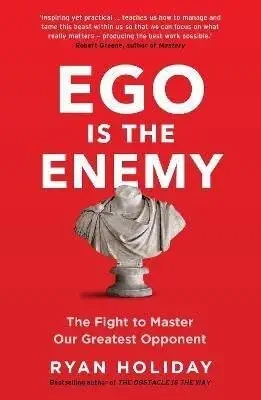
Ego is the Enemy
By Ryan Holiday
Core Book Summary
Ego is the Enemy by Ryan Holiday draws heavily on the ancient philosophy of Stoicism to demonstrate how our own ego is often the greatest hurdle to our success and happiness. Holiday defines ego not in the Freudian clinical sense, but in the colloquial sense: an unhealthy belief in our own importance. It is that voice whispering in our ear that we are better than we are, that we deserve more than we have earned, and that we are the center of the universe. While ambition drives us forward, ego holds us back, blinds us to our faults, and creates unnecessary enemies. The book is brilliantly structured around the three phases of any person's life journey: Aspiration, Success, and Failure. Holiday argues that ego is the enemy at every single stage. In the 'Aspiration' phase, when we are trying to achieve our goals, ego tells us we are already great, making us talk more than we work. Ego wants the recognition before the effort is put in. Holiday advises that during this phase, we must be students, remain humble, and adopt the 'canvas strategy'—finding ways to help others succeed and absorbing knowledge without demanding the spotlight. In the 'Success' phase, ego is perhaps at its most dangerous. Once we achieve something, ego convinces us that we are invincible and that our success was entirely due to our own solitary genius (forgetting luck, timing, and the help of others). It leads to arrogance, overreaching, and a refusal to learn. To survive success, one must maintain an eternal student mindset. We must realize that no matter how much we know, there is always more to learn, and there is always someone better. Holiday emphasizes the importance of staying grounded and focusing on the actual work rather than the accolades. Finally, in the 'Failure' phase, ego magnifies our suffering. When we stumble, ego tells us that it is unfair, that it is someone else's fault, or that our self-worth is permanently destroyed. Ego refuses to accept responsibility, preventing us from learning the lessons the failure offers. The stoic response to failure is to accept it gracefully, analyze the mistakes objectively, and use it as fuel for the next attempt. Ultimately, Ego is the Enemy is a powerful reminder that true greatness comes from humility, continuous learning, and focusing on the purpose rather than the applause.
Key Takeaways
- What is Ego?: In this context, ego is an unhealthy belief in your own importance. It is the arrogance that tells you that you are inherently better, smarter, and more deserving than everyone else.
- Ego in Aspiration (Talk vs. Work): When starting out, ego makes you want the title and the applause before doing the hard work. You spend more time talking about your big plans than actually executing them. Be silent and work.
- To Be or To Do: You must choose between wanting 'to be' somebody (seeking status, fame, and titles) or wanting 'to do' something (focusing on the actual work, impact, and purpose).
- The Canvas Strategy: When you are junior, don't demand the spotlight. Clear the path for your superiors, solve their problems, and make them look good. You will learn invaluable lessons while remaining humble.
- Ego in Success (The Disease of Me): Success is intoxicating. Ego convinces you that your success was inevitable and entirely your own doing. This arrogance blinds you to reality and almost always leads to a painful downfall.
- Remain a Student: The moment you think you have mastered your field, your decline begins. No matter how successful you become, always approach life with the humility of a beginner. There is always more to learn.
- Don't Tell Yourself a Story: Ego loves to create a grand, sweeping narrative about your life, making you the destined hero. In reality, success is the result of messy, hard, unglamorous work. Stick to reality.
- Ego in Failure (The Danger of Pride): When you fail, ego wants to blame everyone else, play the victim, or completely shatter your self-worth. You must detach your personal value from the outcome of your projects.
- Alive Time vs. Dead Time: When faced with a setback or a waiting period, ego sulks (Dead Time). A humble, driven person uses that same period to read, learn, and prepare for the next opportunity (Alive Time).
- Always Stay Grounded: Sweep the floor. Do the menial tasks. Connect with nature or the sheer scale of the universe to remind yourself of how small you truly are. Humility is the antidote to ego.