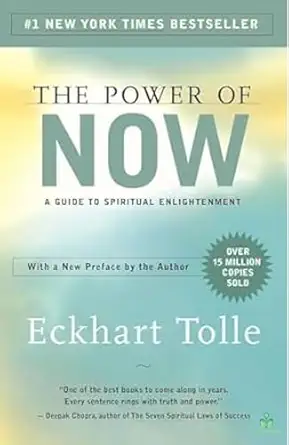
The Power of Now
By Eckhart Tolle
Core Book Summary
The Power of Now by Eckhart Tolle is a transformative spiritual guidebook that has profoundly impacted millions of readers worldwide. At its core, the book presents a seemingly simple but radically life-altering premise: the present moment is the only thing that truly exists, and the constant stream of compulsive thinking in our minds is the root cause of all human suffering. Tolle draws on various spiritual traditions—including Zen Buddhism, Hinduism, and Christian mysticism—but strips away religious dogma to deliver a direct, accessible manual for achieving spiritual enlightenment in everyday life. He argues that most human beings are trapped in their own minds. We are perpetually obsessed with the past, which gives us an illusory sense of identity through our memories and traumas, and we are constantly anxious about the future, searching for salvation, fulfillment, or fear of what might happen. By dwelling in psychological time, we completely miss the depth, peace, and aliveness of the 'Now.' A major concept introduced in the book is the 'Pain-Body.' Tolle describes this as a semi-autonomous energy form consisting of old emotional pain that lives within us. The pain-body feeds on negative thinking and emotional drama; it wants us to feel angry, depressed, or victimized because that is how it survives. When we unconsciously identify with our thoughts and emotions, the pain-body takes over, causing us to lash out at others or spiral into despair. The antidote to this suffering is observation. Tolle teaches readers how to become 'the watcher' or the silent observer of their own minds. When you step back and simply watch your thoughts pass by without judging them or getting swept away by them, you break the illusion that you *are* your mind. You realize you are the deeper consciousness—the silent presence—behind the thoughts. The book heavily emphasizes surrender, which Tolle clarifies is not about passive resignation or giving up. Instead, surrender is the profound inner acceptance of 'what is' without internal resistance. If a situation is intolerable, you either take action to change it or remove yourself from it, but you do so without the toxic inner narrative of anger and complaint. The Power of Now is not a book to be read quickly; it is meant to be experienced. It challenges the ego's absolute control over our lives and invites the reader to step out of the noisy, time-bound mind into the vast, silent, and deeply peaceful realm of pure Being. By anchoring ourselves firmly in the present moment, we unlock access to true joy, profound love, and a state of unshakeable inner peace that is entirely independent of external circumstances.
Key Takeaways
- You Are Not Your Mind: The greatest obstacle to inner peace is identifying entirely with your thoughts. You are not the voice in your head; you are the silent, observing consciousness behind that voice.
- The Illusion of Time: Psychological time is an illusion created by the ego. The past consists only of memory traces, and the future is purely an imagined projection. The 'Now' is the only reality you will ever experience.
- The Pain-Body: We all carry an accumulation of past emotional pain, a negative energy field called the 'pain-body.' It periodically awakens to feed on more pain, drama, and negative thinking. Recognize it to stop feeding it.
- Observe the Thinker: The primary step toward enlightenment is to 'watch the thinker.' Listen to the voice in your head impartially, without judging or condemning what you hear. This detaches your identity from the ego.
- Accept 'What Is': Most human suffering is caused by resisting the present moment. Instead of fighting reality, accept whatever the present moment contains as if you had chosen it yourself. Then, act if necessary.
- The Ego Feeds on Problems: The egoic mind relies on conflict, problems, and complaints to maintain its sense of identity and separation. It secretly does not want an end to your problems because they give it purpose.
- True Love vs. Egoic Love: Ego-based love is addictive and clings to the other person for a sense of completeness, often turning into hate. True love emerges from the stillness of Being and is free of neediness and conditions.
- Find the Joy of Being: True happiness is not found in achieving future goals, acquiring wealth, or finding the perfect partner. It is found by connecting deeply with the pure, simple joy of existing in this exact moment.
- Surrender is Not Weakness: Surrendering to the present moment does not mean you cannot take action to improve your life. It means your actions arise from a place of peaceful clarity rather than frantic, angry resistance.
- Inner Body Awareness: A powerful way to anchor yourself in the Now is to focus your attention on the feeling of life inside your physical body. This draws consciousness away from excessive thinking and grounds you in the present.