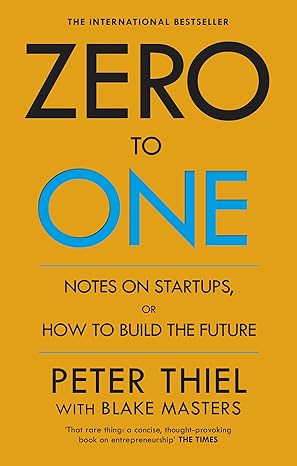
Zero to One
By Peter Thiel
Core Book Summary
Zero to One by legendary entrepreneur and investor Peter Thiel offers a profoundly counterintuitive philosophy on how to build companies that create entirely new things. The book begins by distinguishing between two types of progress: horizontal and vertical. Horizontal progress means copying things that already work—going from 1 to 'n'. This is essentially globalization. Vertical progress, on the other hand, means doing something nobody has ever done before—going from 0 to 1. This is technology. Thiel argues that the next Bill Gates will not build an operating system, and the next Mark Zuckerberg will not create a social network. If you are copying these guys, you aren't learning from them. To achieve massive success, you must go from 0 to 1. The most controversial and thought-provoking thesis in the book is Thiel's stance on monopolies versus competition. According to traditional economic theory, competition is ideal. Thiel argues the exact opposite: 'competition is for losers'. Under perfect competition, all profit margins are driven down to zero, and companies are forced to focus solely on daily survival rather than long-term vision or caring for their employees. A monopoly, however, owns its market. Because it has no direct competitors, it generates massive profits, giving it the freedom and capital to invest in ambitious research and development that actually moves society forward. Google, for example, is a search monopoly, which allows it to fund self-driving cars and life-extension research. So, how do you build a monopoly? Thiel outlines four key characteristics: proprietary technology (which must be at least 10 times better than the closest substitute), network effects (the product becomes more useful as more people use it), economies of scale (the business gets stronger as it gets bigger), and strong branding. However, you cannot capture a massive market on day one. Thiel strongly advises startups to start by dominating a very small, specific niche market. Once you have a monopoly in that tiny pond, you can gradually expand into broader, adjacent markets. Furthermore, Thiel emphasizes the importance of 'secrets'—hidden truths about the world that people don't realize or agree with. Great companies are built on discovering these secrets. He also shatters the 'build it and they will come' myth, highlighting that a brilliant product is useless without an equally brilliant sales and distribution strategy. Ultimately, Zero to One is a call to think for yourself, build the future, and create a unique monopoly rather than fighting in a crowded, competitive market.
Key Takeaways
- Zero to One vs. One to N: Going from 0 to 1 means inventing something completely new (vertical progress/technology). Going from 1 to n means copying something that already exists and scaling it (horizontal progress/globalization).
- Competition is for Losers: Perfect competition destroys profits and forces companies to focus strictly on survival. Monopolies, however, have the profit margins and freedom to innovate and think long-term.
- Proprietary Technology Must Be 10x Better: To create a successful monopoly and convince users to switch from their current solutions, your product cannot just be slightly better; it must be at least 10 times better than the nearest alternative.
- Start Small and Monopolize: Do not try to conquer a massive global market on day one. Start with a very small, specific niche market, completely dominate it, and then slowly expand into adjacent markets (like Amazon did, starting only with books).
- The Power of Secrets: Every great business is built around a 'secret'—a truth about the world that very few people agree with or have noticed. If you only build what everyone else agrees is a good idea, you will face massive competition.
- Sales is Just as Important as the Product: Many tech founders mistakenly believe that a great product sells itself. It doesn't. You need a robust, calculated sales and distribution strategy to get your product into the hands of users.
- The Power Law of Investing: In venture capital, a small handful of successful companies will heavily outperform all other investments combined. As a founder, you must aim for a market so big that you can become one of these massive outlier successes.
- Computers are Complements, Not Replacements: Instead of fearing that AI and computers will replace human workers, Thiel argues that the most successful businesses will use computers to complement and elevate human capabilities.
- Foundations Matter: A startup messed up at its foundation cannot be fixed. Choosing the right co-founders, aligning incentives, and creating a strong, almost 'cult-like' company culture are crucial for long-term survival.
- Network Effects and Economies of Scale: A monopoly is sustained when a product becomes more valuable as more people use it (network effects) and when the cost of adding a new customer drops as the business grows (economies of scale).