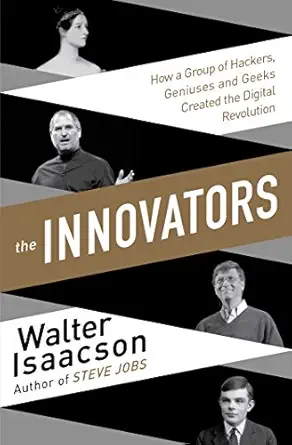
The Innovators
By Walter Isaacson
Core Book Summary
The Innovators: How a Group of Hackers, Geniuses, and Geeks Created the Digital Revolution by Walter Isaacson is a sweeping, comprehensive, and masterfully detailed history of the digital age and the extraordinary individuals who built the computer and the internet. Moving away from the popular cultural myth of the lone genius toiling away in a solitary garage to change the world, Isaacson's central thesis is that the most significant and enduring technological leaps in human history are the product of deep, sustained, and often complex collaboration. True innovation happens when visionaries with bold, abstract ideas partner with practical, grounded engineers who can execute those ideas, often backed by shrewd business leaders who understand how to bring a product to market. The narrative traces a fascinating lineage starting in the 1840s with Ada Lovelace, Lord Byron's daughter, who first grasped the concept of general-purpose computing and foresaw that Charles Babbage's machines could process not just numbers, but any form of information, including music and art. From there, Isaacson takes readers through the brilliant but tragic life of Alan Turing, who conceptualized the universal machine, and the pivotal wartime efforts at Bletchley Park and the ENIAC project, where largely uncredited teams of women programmed the first giant electronic computers. The book then thoroughly explores the post-war era, detailing the highly collaborative and cross-disciplinary environment at Bell Labs that birthed the transistor. It chronicles the subsequent invention of the microchip by Robert Noyce and Jack Kilby, a breakthrough that fundamentally paved the way for the personal computer revolution. Isaacson carefully examines the symbiotic, often volatile relationships that drove progress, such as the hardware-software partnership of Steve Wozniak and Steve Jobs at Apple, and the operating system dominance established by Bill Gates and Paul Allen at Microsoft. He also delves deeply into the creation of the internet, highlighting how a decentralized network was built by a collaborative community of academic researchers, heavily funded by the government, and how Tim Berners-Lee’s invention of the World Wide Web brought this vast network to the masses. Throughout this epic historical journey, Isaacson emphasizes that the most successful innovators were those who could operate seamlessly at the intersection of the humanities and the sciences. They were not just brilliant mathematicians or hardware engineers; they were individuals who deeply understood human psychology, art, aesthetics, and design. The book ultimately serves as a powerful testament to the necessity of teamwork, open-source sharing, and the enduring ethos of hackers who believed that information should be free and accessible to all. It is a profound reminder that while individual brilliance is absolutely essential, it is the collective ability to work together, share ideas transparently, and iterate on each other's successes that truly changes the fabric of society.
Key Takeaways
- The Myth of the Lone Genius is False: The digital age was not built by isolated inventors having sudden 'eureka' moments in solitary garages. Instead, it is the direct result of highly collaborative teams, open ecosystems, and the continuous sharing of ideas where abstract visionaries partnered closely with practical hardware and software engineers.
- Ada Lovelace's Poetic Science: Ada Lovelace, the 19th-century mathematician, was the very first to understand that Charles Babbage's Analytical Engine could process much more than just mathematical numbers. She foresaw that computers could manipulate any symbol, including music and text, establishing the foundational concept of modern computing and the intersection of technology and the arts.
- Alan Turing and the Universal Machine: Alan Turing conceptualized the idea of a logical, universal machine that could perform any computable task simply by reading instructions from a tape. His brilliant theoretical work during World War II not only helped crack the Enigma code but also laid the absolute intellectual groundwork for all modern, general-purpose computers.
- The Power of Institutional Collaboration: Massive breakthroughs like the invention of the transistor were not random accidents. They were the deliberate result of managed environments like Bell Labs, which intentionally forced theorists, experimentalists, metallurgists, and practical engineers to work in close physical proximity, fostering the unexpected cross-pollination of ideas.
- Hardware and Software Symbiosis: The greatest leaps in computing history occurred when brilliant hardware engineers teamed up with visionary software creators or marketers. Steve Wozniak's elegant circuit board design for the Apple II required Steve Jobs's vision to package and sell it, just as early IBM hardware machines desperately needed Microsoft's software to become truly ubiquitous.
- The Government and Academic Ecosystem: The foundational architecture of the internet was fundamentally a creation of government funding and academia, not private enterprise. Funded by ARPA, the early internet relied on a decentralized, collaborative network of university researchers who prioritized open protocols and robust communication over proprietary corporate profit.
- The Open Source Ethos: The free sharing of ideas and open, peer-to-peer collaboration has been a massive driver of modern technological progress. The culture of the early internet, championed by figures like Linus Torvalds with Linux and the creators of Wikipedia, proved that decentralized cooperation could build tools as powerful as those created by massive corporations.
- The Intersection of Arts and Sciences: The most creative and disruptive leaps in the digital revolution often occurred at the exact intersection of the arts and the sciences. Innovators like Steve Jobs succeeded wildly because they believed that technology alone was not enough; it had to be deeply married with liberal arts, intuitive design, and a profound understanding of human behavior.
- Women in Computing: Women played an absolutely critical, yet historically overlooked and underappreciated, role in the dawn of computing. From Ada Lovelace to the brilliant female mathematicians who meticulously programmed the ENIAC (the first electronic general-purpose computer), women were the original software engineers while men primarily focused on building the hardware.
- Humans Augmenting Machines: The most enduring and successful advancements in computing have consistently focused on augmenting human intelligence and creativity rather than trying to entirely replace human capabilities with artificial means. The ultimate goal has always been to create a symbiotic relationship where humans and computers work seamlessly together to solve complex problems.