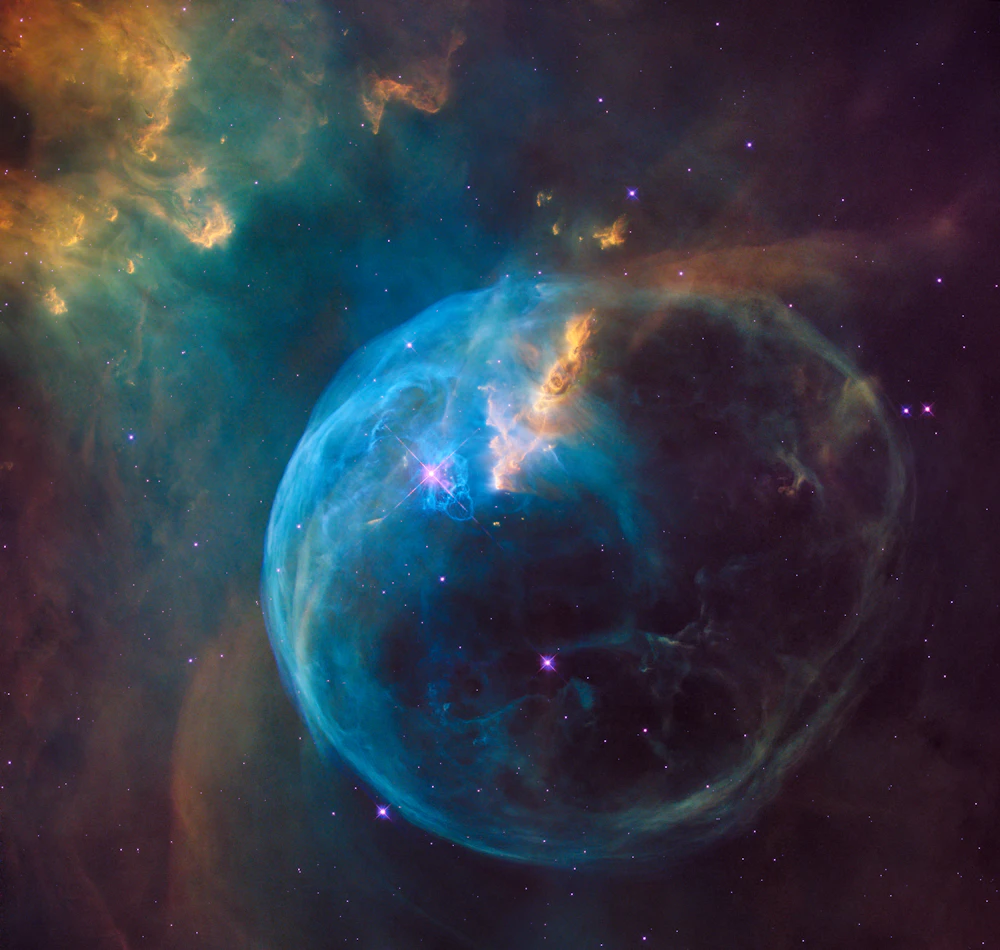
Every time you look up at the night sky, you are looking into the past. Because light travels at a finite speed of roughly 300,000 kilometers per second, you never see any cosmic object as it is “right now.” You see the Moon as it was 1.3 seconds ago; you see the Sun as it was 8 minutes and 20 seconds ago; you see the bright star Sirius as it was 8.6 years ago; and when you look at the Andromeda Galaxy with the naked eye on a clear autumn night, the photons hitting your retina left those stars 2.5 million years ago, when early hominids were chipping stone tools in East Africa.
Telescopes, therefore, are literal time machines. The fainter and more distant the light a telescope can collect, the further back toward the Big Bang it can see. For three decades, the Hubble Space Telescope revolutionized astronomy by orbiting 540 kilometers above Earth and capturing breathtaking visible-light portraits of the universe. Yet when astronomers tried to use Hubble to look all the way back to the very first stars and galaxies born after the Big Bang, they hit an impenetrable physical wall.
Why We Needed an Infrared Eye in Deep Space
Why couldn’t Hubble see the very first galaxies? The culprit is cosmological redshift. Because the fabric of space itself has been expanding continuously since the Big Bang 13.8 billion years ago, the light waves emitted by the earliest stars have been stretched out as they traveled across the expanding universe—just like the pitch of an ambulance siren drops as it speeds away from you.
Light that left the first baby galaxies 13.5 billion years ago as bright ultraviolet and visible light has been stretched by the expansion of space all the way into the infrared spectrum—heat radiation that is completely invisible to human eyes and to Hubble’s optical detectors. Even worse, infrared light enables a second superpower: while visible light is blocked by thick clouds of cosmic dust inside star-forming nebulae, longer infrared wavelengths pass right through the dust like an X-ray, revealing newborn stars and planets hidden inside.
To capture those whisper-faint infrared photons from the dawn of time, engineers at NASA, ESA, and CSA had to solve a terrifying problem: an infrared telescope is a heat detector, which means the telescope’s own warmth will blind it unless it is kept colder than minus 220°C.
“With 344 single-point failures during deployment, the James Webb Space Telescope was the most complex robotic origami humanity ever launched into the void.” — Mission Engineering Log
The Engineering Marvel at Lagrange Point 2
Launched on December 25, 2021, the James Webb Space Telescope (JWST) could not orbit close to Earth like Hubble, because the glowing heat of Earth and the Moon would swamp its instruments. Instead, Webb traveled 1.5 million kilometers away from Earth—nearly four times further than the Moon—to a gravitational balance point called Lagrange Point 2 (L2).
Because its 6.5-meter primary mirror (composed of 18 hexagonal segments made of ultra-lightweight beryllium coated in a microscopic layer of pure gold to reflect infrared light) was too wide to fit inside any rocket fairing on Earth, the entire telescope had to fold up like a piece of Japanese origami:
- The Five-Layer Tennis-Court Sunshield: To block the heat of the Sun, Earth, and Moon, Webb unfurled five paper-thin membranes of Kapton coated in aluminum and doped silicon. On the hot, sun-facing side of the shield, temperatures reach a scorching +85°C (185°F); just inches away on the shaded telescope side, temperatures plunge to minus 233°C (minus 388°F)—only 40 degrees above absolute zero.
- Nanometer Mirror Actuators: Behind each of the 18 gold mirror segments sit tiny robotic motors capable of adjusting the curvature and alignment of the mirror in steps of 10 nanometers—one ten-thousandth the width of a human hair—allowing all 18 segments to focus light as a single flawless optical surface.
3 Discoveries That Shook Cosmology
Since beginning full scientific operations, JWST has delivered one surprise after another, forcing astrophysicists to rethink how the early universe evolved:
1. “Impossible” Early Galaxies at Cosmic Dawn
Before Webb launched, standard cosmological models predicted that after the Big Bang, it should have taken hundreds of millions of years for gravity to slowly gather primordial hydrogen gas into small, messy clumps that eventually merged into large galaxies. Yet when Webb peered back to just 280 to 400 million years after the Big Bang (galaxies like *JADES-GS-z14-0*), it discovered galaxies that were shockingly bright, massive, and already rich in heavy elements like oxygen and carbon. Either stars formed with far higher efficiency in the early universe than our physics equations assumed, or giant primordial black holes accelerated galactic birth in ways we are only beginning to model.
2. Sniffing the Atmospheres of Alien Worlds (Exoplanets)
How do you find out what the air is made of on a planet orbiting a star hundreds of light-years away? When an exoplanet passes directly in front of its host star (a transit), a tiny fraction of the starlight filters through the planet’s thin ring of atmosphere before reaching Webb’s spectrographs. Because every chemical molecule absorbs specific infrared wavelengths like a barcode, Webb has detected water vapor, carbon dioxide, sulfur dioxide, and methane in the atmospheres of distant worlds—and is actively scanning rocky, Earth-sized planets in the TRAPPIST-1 system and sub-Neptunes like K2-18b for atmospheric biosignatures.
3. Supermassive Black Holes Born Too Fast
At the center of almost every large galaxy sits a supermassive black hole weighing millions or billions of times the mass of our Sun. Webb has spotted hungry supermassive black holes thriving less than 500 million years after the Big Bang—far too massive to have grown gradually from the collapse of a single normal star. This strongly supports the theory of “direct-collapse black holes,” where colossal clouds of primordial gas collapsed directly into black holes weighing 100,000 suns without ever becoming stars first.
We Are the Universe Looking Back at Itself
Perhaps the most moving truth revealed by Webb’s infrared spectrographs is chemical: the calcium in your bones, the iron in your blood, and the carbon in your DNA were forged inside the nuclear furnaces of ancient stars that lived and died billions of years ago. When we look at a James Webb deep-field image containing ten thousand galaxies in a patch of sky the size of a grain of sand held at arm’s length, we are not looking at a foreign world—we are looking at our own cosmic family album.